Danny Province's position:
Men's Issues
There is a big debate today about if men are facing an independent crisis, or if they are just suffering more from the same social problems as women. The confusion comes from comparing the results rather than the causes in three topic areas: economics, education, and social connections. Using the economics example, women seem to be outperforming men now when they have the same qualifications. For people under 30, the wage gap has closed to women earning 95¢ for every $1 a man earns, the smallest it has ever been. This could be that men are failing in a way that women aren't, or it could be that both men and women are suffering from the same economic headwinds, just more so for men. So let me explain my starting points and how that guides my understanding of the recommended policy responses.
Men and Women are both not the cause of Men's problems.
Right now, the right seems to insist on blaming feminism and the loss of traditional gender roles. Feminism's main gains were in the 1970's - 2000's. Since then, feminists have simply been on the defensive, trying to limit how much conservatives are able to roll back those gains. But the men's crisis really only kicked off in the 2010's, for example with a significant number of men losing work after the great recession. There was another drop off after covid-19 with a recovery to the 2010's level you can see on that same chart.

Men got by for decades just fine with feminism. It is true that men can gain economically from suppressing women's rights, but they do not have to suppress women in order to gain economically: and that's what the conservative position to roll back feminism really implies. Even if conservatives were right, I still wouldn't support their attacks on women because we should not try to succeed through disadvantaging others as a matter of morals.
That said, I also hear an equally troubling narrative from the left: "What's the Matter with Men?" You see a penchant for leftists throwing shade at the idea there even is a men's crisis. When they do accept it, people on the left or center-left tend to think men have brought it on themselves. This is most acute in the realm of dating, where there is an underlying current of belief that if a man can't date or find a relationship, then its a problem with him in particular. There is an assumption that maybe he's already a toxic Andrew Tate acolyte, or he doesn't take care of himself, or he isn't "economically viable," or he's too scared to put himself out there, etc. etc. There's such a variety of could-be red flags, but the underlying assumption is if you were a decent man, you could get a girlfriend.
I think the narratives that locate the fault within men themselves are just as wrong and harmful as the anti-feminism narratives on the right. Does anyone really think young men today are more sexist than 50 years ago? Or that men have worse hygiene than 50 years ago? The next step of the argument typically borrows from the anti-feminist narrative: that men were always "this bad" and that now that women are closer to equality, men can't compensate through the subjugation of women anymore. Usually with some evolutionary-pop psychology sprinkled over it to give it a veneer of academic legitimacy on the left. However we know that men's support for feminism kept increasing until the last several years when it fell off a cliff.
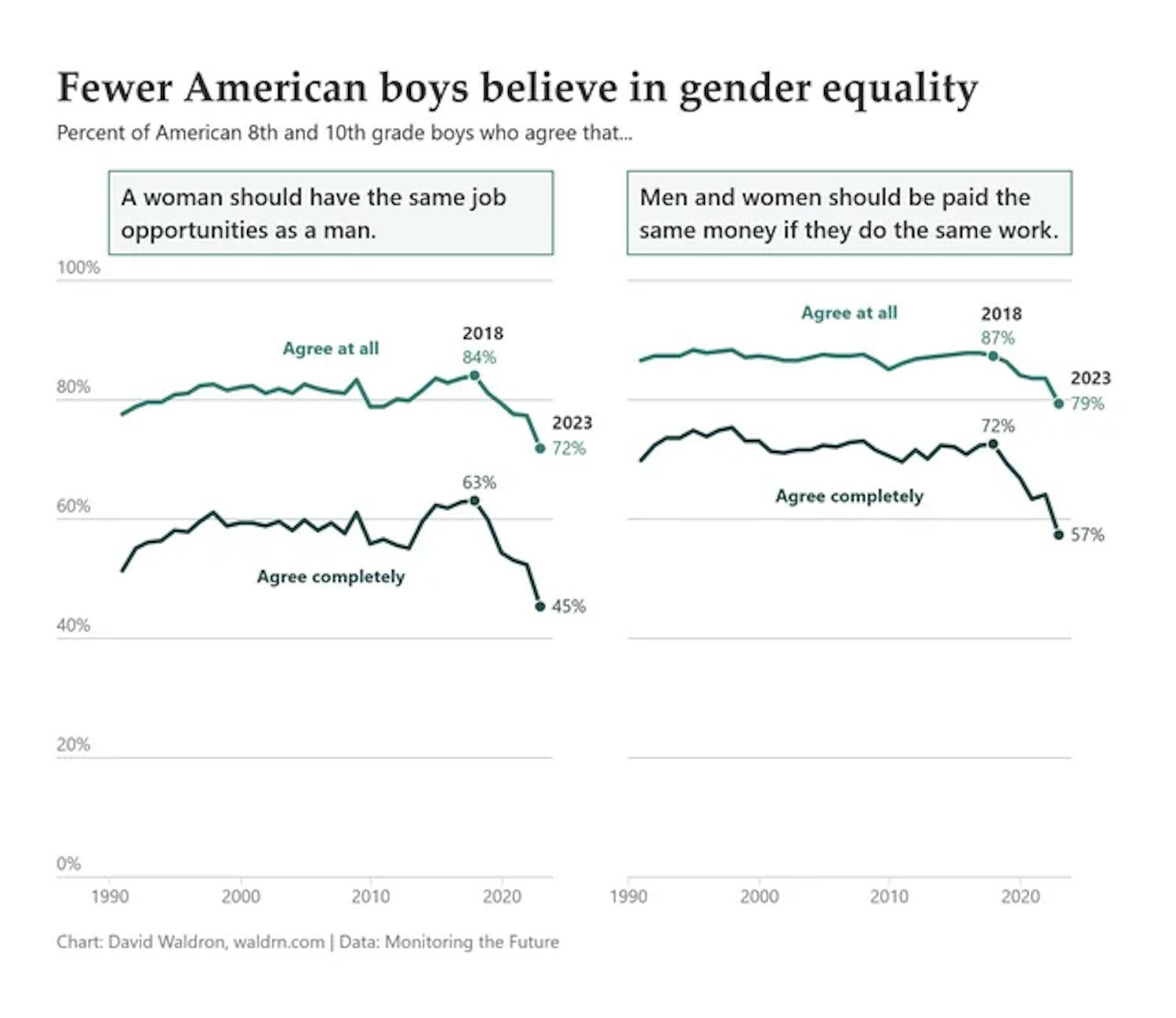

After this step of the argument, they modify it to claim that boys have recently changed for the worse, usually blaming technology, video games, and social media. That also flies in the face of findings like this one that the more online men are, the less sexist they become. Higher internet usage is also associated with higher economic status, not lower. The men using technology more tend to be less toxic and wealthier than those who are more offline.
These poor diagnoses have undermined the quality of proposed solutions. The right's attack on non-traditional gender roles doesn't actually help whatever is really hurting men; it just subjugates women as a form of compensation. The left's approach, to treat it as though something in men's nature is the real cause of their problems, leads to disregard for their pain.
The solution for men is not endurance
When the DSM which guides psychological treatment addressed toxic masculinity, they were addressing something real and argued for rethinking what masculinity means. Unfortunately, the view that has emerged years later might be best summarized by Scott Galloway's Provide, Protect, Procreate. His approach was to jettison the masculine traits labeled toxic (e.g. aggression, conflict-oriented) and to stitch back together the remaining parts. I think the result is unfortunate, because in the absence of the ability to "win rewards," it seems to me this in practice becomes a call to endure. This is what I hear:
It may be incredibly difficult to succeed in today's American economy, but men should just endure the process and try their best anyways. Work long hours, tolerate tough working conditions, put up with poor treatment; because what it means to be a man is to endure the rat race until you succeed. Conflict is justified by being on defense: that you should put yourself out there to endure attacks so that your loved ones don't have to. But conflict for personal gain is still innately suspect. In the realm of social connection, men should endure as much rejection as possible. Work out more, do more housework, find whatever ways to make yourself more valuable you can; sacrifice enough to make yourself desirable to others. Don't overburden them with your own emotions or needs, you should endure your emotions and needs and have so much social connection that nobody has to support you: you support them.
If what defines men is their ability to endure, then what defines men is their sacrifice and suffering. This is an accident; its not as though Scott Galloway or similar thinkers went out of their way to position men this way. Instead, we need to reject the method of trying to stitch back together masculinity from traditions that remain when its more toxic aspects are removed. What makes a man has to be rethought anew.
Similarly, I reject solutions that are based upon there being something wrong with men that needs some kind of fix. For example, I reject the proposal to redshirt all boys and hold them back one year in school compared to women. The individual variation in education ability is far greater than the difference between boys and girls at school; holding all boys back a year only stigmatizes them as inferior, and that would be more harmful than beneficial.
What men need is pathways to success
The solutions that men need are relief for the headwinds affecting them. In the realm of education, both boys and girls need help when they academically struggle. If boys perform better with competition and status rewards, we should have more competition and status rewards in school or force the students to participate more, as we already force them to take P.E. in the assumption that exercise is helpful. If boys do better with more exercise, increase the amount of PE too. We have lots of research on what boys respond to in school, so we should just be implementing more school structures that work well for them, not holding them back until school is easy enough that it doesn't matter what school structure they have.
In the economic area, what men need is solutions for industries that men traditionally have worked in, like construction or natural resource extraction. There is $9 trillion of infrastructure work the US needs done over the next decade, but at our current rate we'd only spend around $6 trillion in that time period. We do not need to exclude women from that work at all, we just need to fully fund the work. Men make up 2/3 of the workforce in the green energy industry, and the Republicans just took a chainsaw to that sector instead of continuing to fund the build-out. Same situation for the agriculture industry. Better economic management will go a long way to helping men.
Social connection is the hard one. There is some work on how city planning can contribute to third spaces, places that help increase social connection. However, social connection is not something anyone can mandate. We can nudge it but we can't engineer it with social policy. That's the area that I'm still thinking through, and if anyone reading this has suggestions go ahead and send them to me because I'm still looking.